What Are the Best Air Conditioning Suppliers in China?
Choosing among the best air conditioning suppliers in China requires more than comparing factory prices. Buyers must examine engineering capability, product consistency, certifications, warranty support, and export experience. A reliable supplier should explain its testing process clearly. It should also provide stable documentation, traceable components, and realistic delivery schedules.
Professor Jeffrey D. Spitler, a respected HVAC researcher, has emphasized, “The purpose of HVAC design is to create a comfortable and healthy indoor environment.” This principle matters when evaluating Chinese manufacturers. A low-cost unit may appear attractive under showroom lighting. However, its real value becomes clearer during a humid summer, when compressors run continuously and service teams must respond quickly.
The strongest suppliers usually support multiple applications. These may include residential split systems, commercial VRF equipment, rooftop units, chillers, and heat pumps. Their factories often show organized assembly lines, controlled refrigerant charging, and documented quality inspections. Ask for performance data at different outdoor temperatures. Also check how the supplier handles spare parts after installation.
Experience still matters. A supplier with ten years of overseas projects may understand local voltage, climate, installation habits, and import requirements. Yet experience alone is not proof of quality. I have seen attractive catalogs hide weak after-sales systems. That is an uncomfortable point, but it deserves attention.
This guide compares leading Chinese manufacturers through a practical lens. It considers technology, reliability, customization, certifications, support, and total ownership cost. The goal is not to promote one brand. It is to help buyers choose air conditioning equipment with greater confidence, including solutions connected to broader building services and air conditioning.
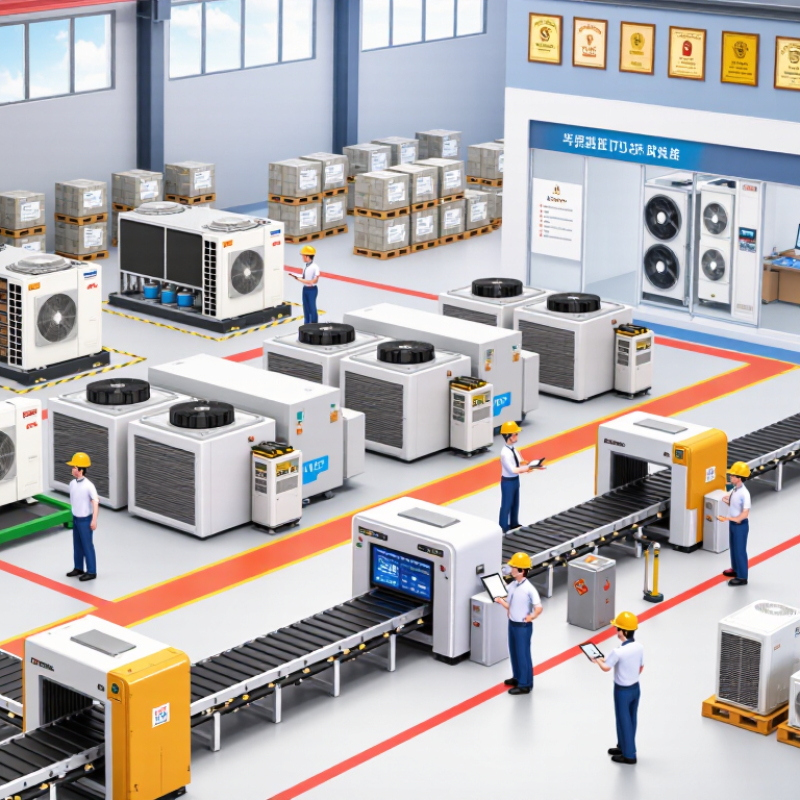
China’s AC Supply Chain: Over 80% of Global Room-AC Production
China’s air-conditioning supply chain produces over 80% of the world’s room air conditioners, making the country a central sourcing hub. This scale rests on more than final assembly. Regional networks supply compressors, copper tubing, heat-exchanger coils, motors, control boards, and molded housings. In a factory, these parts meet along production lines where leak checks, electrical tests, and noise measurements help catch defects before shipment.
Scale matters. But it does not guarantee consistent quality. Buyers should check whether a supplier can share recent test records, explain component traceability, and show how it handles changes between production batches. A walk-through can reveal practical details: organized parts storage, calibrated testing equipment, and clear separation between inspected and uninspected units. Capacity figures deserve careful review, too; a large stated output may not reflect current utilization or available engineering support. Even strong documentation has limits. A sample may perform well while later batches vary, so independent inspections and agreed acceptance criteria remain useful when comparing suppliers.
What Are the Best Air Conditioning Suppliers in China? — China’s AC Supply Chain: Over 80% of Global Room-AC Production
| Supply-Chain Dimension | Data or Industry Fact | What Buyers Should Evaluate |
|---|---|---|
| Global manufacturing position | China produces more than 80% of the world’s room air conditioners, according to the estimate stated in the article title. The share can vary by year and by how “room air conditioner” is defined. | Confirm the supplier’s product category, manufacturing location, export experience, and available production capacity. |
| Domestic production scale | China’s official industrial statistics reported approximately 224.8 million household air-conditioning units produced in 2023. | Ask for current, model-specific capacity and lead times; national output does not indicate an individual factory’s capacity. |
| Manufacturing clusters | Air-conditioning and component manufacturing activity is concentrated in several eastern and southern coastal provinces, including Guangdong, Zhejiang, Jiangsu, and Anhui. | Check factory location, access to component suppliers, port logistics, and the availability of local technical support. |
| Core components | A typical room-AC supply chain includes compressors, heat exchangers, fans, motors, electronic controls, refrigerant tubing, sheet-metal parts, and plastic housings. | Review critical-component specifications, approved-substitute policies, traceability, and incoming inspection procedures. |
| Materials and commodity exposure | Copper and aluminum are commonly used in refrigeration circuits and heat exchangers; steel and engineering plastics are used in structural and enclosure parts. | Clarify material grades, coil construction, corrosion protection, and how material-price changes are handled in quotations. |
| Refrigerants | R-32 and R-410A are refrigerants used in room air-conditioning products. Their suitability and permitted use depend on local regulations, safety requirements, and product design. | Verify the refrigerant, charge quantity, applicable safety labeling, local regulatory compliance, and service requirements for the destination market. |
| Product testing and standards | Room air conditioners are tested against applicable performance and safety requirements. IEC 60335-2-40 is an international safety standard relevant to electrical heat pumps and air conditioners; destination-market rules also apply. | Request reports for the exact model and market, and verify that certificates and test results match the shipped product configuration. |
| Energy performance | Cooling capacity, energy efficiency, and test conditions are market-specific; rating labels and minimum-efficiency rules differ between jurisdictions. | Compare products using the destination market’s required test method and efficiency metric, not headline figures alone. |
| Export readiness | China’s large manufacturing base supports both domestic sales and international supply, but export documentation and product approvals vary by destination. | Confirm customs documentation, labeling, packaging, electrical compatibility, warranty terms, and any required local registrations before ordering. |
| Supplier due diligence | Production volume at the country level is not a substitute for assessing an individual supplier’s factory, quality system, or financial and delivery performance. | Conduct a factory audit, inspect samples, agree on acceptance criteria, and consider independent pre-shipment inspection. |
Data note: The 2023 production figure refers to China’s reported household air-conditioner industrial output. The global share is the estimate given in the headline; definitions and annual estimates may differ across sources.
Related Posts
-
What is Domestic Air Conditioning and How Does It Work?
-
2026 Best Residential Air Conditioning Systems for Homeowners?
-

Top 10 Residential Air Conditioning Systems for Global Buyers?
-

Top Air Conditioning Installation Services in China for Global Buyers?
-

How to Maintain Your Air Conditioning System for Optimal Performance?
-

Top 10 Domestic Air Conditioning Brands in China for Global Buyers?