China Best Residential Air Conditioning Installation Guide

Choosing the right system is only part of creating a comfortable home. Residential air conditioning installation also requires careful planning, accurate measurements, and dependable workmanship. A quiet outdoor unit may look ideal, yet poor placement can increase vibration, noise, and maintenance problems. The same applies indoors. An undersized system may run constantly, while an oversized unit can cool quickly but leave rooms damp.

This guide explains practical decisions from the first site inspection to final testing. It considers room size, sunlight, insulation, ceiling height, window direction, and local climate. These details help professionals calculate the cooling load instead of relying on rough guesses. They also guide equipment selection, pipe routing, electrical preparation, condensate drainage, and airflow balancing. Small oversights matter.

Experienced installers check wall strength, service access, and outdoor clearance before drilling. They protect flooring, seal openings, and test for leaks before charging or commissioning the system. Manufacturer instructions and applicable local requirements remain essential. A qualified technician should handle refrigerant, electrical connections, and safety checks.

No installation plan is perfect. A hidden beam may change the pipe route. An unexpected drain slope may require revision. That is normal, but it deserves honest attention. This guide encourages homeowners to ask clear questions, review written estimates, and request commissioning records. Comfort should not depend on guesswork. It should come from measured design, careful installation, and responsible follow-up.
China Best Residential Air Conditioning Installation Guide

Understanding China’s Residential Air Conditioning Systems

China’s residential air-conditioning systems usually fall into two practical groups: room-based split units and concealed multi-room systems.

A split unit serves one room with an indoor coil, outdoor compressor, refrigerant lines, and a condensate drain. Multi-split and ducted systems connect several rooms to one outdoor assembly. They save balcony space, but pipe routing becomes more demanding. Not always simple. In apartments, ceiling height, shaft access, and outdoor-unit limits shape the design before cooling capacity is selected.

Climate changes the installation logic. Humid southern cities need reliable drainage and corrosion-resistant supports. Northern homes may need heating performance, defrost control, and insulated condensate piping. Measure each room’s area, window exposure, occupancy, and heat from kitchens or electronics. Do not size equipment only by floor area. I have seen an oversized unit cool quickly, then cycle poorly and leave the room clammy. That mistake feels efficient, but it is not.

A dependable installation uses sealed copper joints, pressure testing, vacuum evacuation, and insulation without crushed sections. The drain should have a visible slope or a serviceable pump. Details matter. Leave access around filters and electrical isolators. Commissioning should check airflow, operating current, temperature difference, noise, and leakage. Qualified technicians should verify electrical protection and local requirements.

Fresh air is not automatically provided by a standard split system. This is easy to overlook. Even a careful plan may need revision after walls, furniture, or drainage points change.

Selecting the Right Air Conditioner for Your Home

Choosing a home air conditioner starts with the room, not the sales label. Measure floor area, ceiling height, window direction, insulation, and daily occupancy. A south-facing room with weak insulation needs more capacity than a shaded bedroom. Cooling capacity should follow a room-by-room heat-load calculation, not floor area alone. Measure twice.

The International Energy Agency reported in The Future of Cooling that global space-cooling electricity demand could triple by 2050 without stronger efficiency improvements. This makes seasonal efficiency an important selection factor.

Compare the unit’s rated cooling capacity, seasonal efficiency ratio, standby consumption, and operating noise.

Variable-speed systems usually adjust output more smoothly, reducing temperature swings and frequent starts. However, higher efficiency does not guarantee lower bills if the unit is oversized or poorly installed. That part is often underestimated.

In humid areas, choose a system that can remove moisture while maintaining stable temperature. Ask the installer to check refrigerant piping length, drainage slope, airflow, and outdoor-unit clearance.

The U.S. Department of Energy warns that oversized systems may cool quickly but dehumidify poorly.

A slightly uncomfortable truth: the cheapest quotation may hide unsuitable sizing or weak commissioning. Record the model data, installation date, and test readings. Keep the filter accessible; a dusty filter quietly reduces airflow. Comfort is personal. Recheck the choice after one summer.

Preparing for a Safe and Efficient Installation

China Best Residential Air Conditioning Installation Guide

Preparing for a Safe and Efficient Installation

A safe installation begins with a room-by-room cooling assessment. Measure floor area, window direction, insulation, and ceiling height. A unit that is too large may cycle frequently and leave indoor air damp. A unit that is too small may run continuously on hot days. Qualified technicians should inspect the electrical circuit, wall strength, drainage route, and outdoor unit position. Local building and electrical requirements must guide every decision.

Tips: Keep the indoor unit level. Use firm wall supports. Leave clear airflow around the outdoor unit. Protect refrigerant lines from sharp bends and direct sunlight. Test the drain with clean water before closing the wall. After connection, technicians should evacuate the lines, check for leaks, and verify operating pressure. Never skip these steps.

Good installation is quiet, clean, and measurable. Check supply temperature, airflow, vibration, and remote control response. Listen for unusual buzzing. It often signals a loose panel or electrical issue. In real homes, small mistakes can cause major comfort problems later. Even experienced installers may overlook condensate slope when working quickly. That deserves a second inspection. Record the test results, wiring condition, and maintenance access for future service. A neat finish matters, but safety matters more.

Installing Indoor and Outdoor Air Conditioning Units

China Best Residential Air Conditioning Installation Guide

Installing Indoor and Outdoor Air Conditioning Units

A reliable installation begins with a room assessment, not with unpacking the unit. Measure the room, check sunlight, ceiling height, insulation, and window exposure. An experienced technician should calculate the cooling load before selecting capacity. Oversized equipment may cycle too often and leave the room damp.

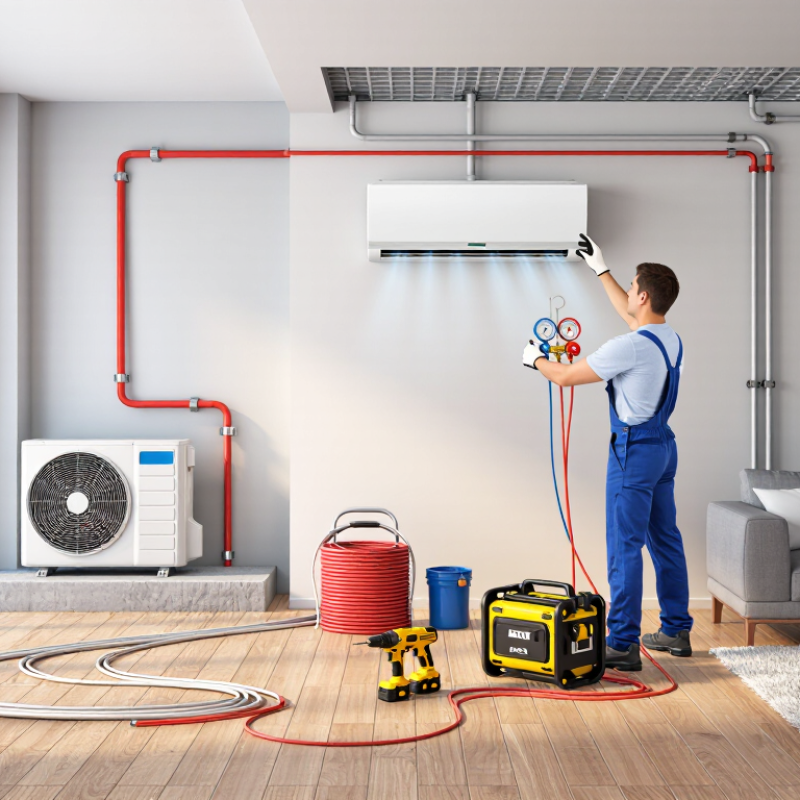
Mount the indoor unit on a solid, level wall, away from curtains and heat sources. Leave enough space above it for airflow and future servicing. The drain pipe needs a steady downward slope, with no sharp bends or trapped sections. Test it with clean water. Small drainage mistakes can cause ceiling stains later.

Place the outdoor unit on a firm base with open airflow around its coil. Keep it away from bedroom windows when possible, because vibration travels farther at night. Connect refrigerant lines carefully, insulate every joint, and protect the pipes from rain and direct sunlight. Electrical work must follow local requirements and include proper grounding. A qualified technician should pressure-test the system, vacuum the lines, and check for leaks before opening the refrigerant circuit. Do not skip this. The system may still start, but poor preparation can shorten compressor life. Even careful installers sometimes miss a slight pipe bend, so a final inspection is worth the extra minutes.

China Best Residential Air Conditioning Installation Guide - Installing Indoor and Outdoor Air Conditioning Units

Installation Category Recommended Dimension or Requirement Installation Guidance Verification Point
Room Capacity Assessment Approximately 100–150 W of cooling capacity per square metre for typical residential rooms Select capacity after considering room area, ceiling height, window exposure, insulation, occupancy, appliances, and local climate. A professional heat-load calculation is preferred. The selected unit should not be substantially oversized or undersized for the room.
Indoor Unit Location High on a solid wall; keep the air outlet and return-air inlet unobstructed Avoid locations directly above doors, heat sources, curtains, wardrobes, or areas exposed to water. Position the unit to distribute air evenly throughout the room. Wall can support the unit and allows access for filter cleaning and service.
Indoor Unit Clearance At least 100–150 mm above the unit where specified; maintain side clearance according to the installation manual Clearances vary by model. Do not block the top air intake, front outlet, side panels, or service cover. Confirm the manufacturer’s minimum clearance before drilling.
Mounting Plate Level, securely fixed to structural material or suitable anchors Use a spirit level. Reinforce weak plasterboard or masonry as necessary. Mark the pipe, cable, and drain opening only after checking the indoor unit dimensions. The plate is rigid, level, and free from movement under load.
Wall Penetration Commonly about 65–80 mm diameter, subject to the equipment design Drill with a slight downward slope toward the outside to support condensate drainage. Seal the opening around the pipe bundle to prevent water, insects, and air leakage. No hidden electrical, plumbing, or structural services are damaged.
Condensate Drain Continuous downward fall; avoid kinks, trapped sections, and upward loops Use a properly sized, insulated drain hose where required. Route the outlet to an approved drainage point and prevent the end from sitting in standing water. Pour water into the drain pan and confirm a free flow with no leakage.
Refrigerant Pipe Route Use the pipe diameters, maximum length, and height difference specified for the unit Keep copper tubing clean, dry, capped, and protected from sharp bends. Insulate the suction and liquid lines as required by the installation manual. No crushed tubing, exposed insulation gaps, or contamination is present.
Outdoor Unit Position Stable, level base or approved wall bracket with adequate airflow Place the unit away from blocked corners, corrosive fumes, excessive dust, and locations where discharged air recirculates into the coil. The unit is protected from flooding, falling objects, and unreasonable vibration.
Outdoor Unit Clearance Typically at least 300 mm from a wall on the air-inlet side and 600 mm or more in front of the discharge side, unless the manual requires more Maintain all model-specific top, rear, side, and front clearances. Do not enclose the unit without engineered ventilation. Air can enter and leave freely during both cooling and heating operation.
Vibration Control Use rubber isolation pads or approved vibration mounts where appropriate Secure the outdoor unit with corrosion-resistant fasteners. Avoid direct contact with lightweight panels that may amplify noise. No abnormal movement, rattling, or excessive structure-borne noise occurs.
Electrical Supply Dedicated circuit, correctly rated breaker, isolator, earthing, and cable size Electrical work must comply with applicable local codes and be completed by a qualified electrician. Never select cable or protection solely from nominal cooling capacity. Voltage, frequency, breaker rating, grounding, and residual-current protection match the installation requirements.
Refrigerant Connections Flared or other approved joints tightened to the specified torque Use clean, correctly sized tools and tubing. Do not reuse damaged flare ends. Keep open pipe ends sealed until connection. All joints pass a leak test before insulation and final concealment.
Evacuation and Leak Testing Evacuate with a vacuum pump to the level and hold time specified by the equipment procedure Use a suitable manifold and micron gauge where available. Pressure-test only with the approved inert gas and pressure stated in the service documentation. Vacuum remains stable and no refrigerant leakage is detected.
Pipe and Cable Finishing Bundle neatly without compressing the drain hose or sharply bending the copper lines Protect external pipework with UV-resistant trunking or suitable weatherproof insulation. Keep electrical wiring separated and secured. Insulation is continuous, dry, protected, and securely supported.
Initial Commissioning Operate cooling and heating modes where available for a sufficient test period Check airflow, temperature response, condensate drainage, outdoor fan operation, abnormal noise, vibration, and control functions. No fault code, water leak, unusual odour, icing, or abnormal sound is observed.
Safety and Handover Provide operating, cleaning, isolation, and maintenance instructions Explain filter cleaning, remote-control use, emergency isolation, service intervals, and symptoms requiring professional attention. Refrigerant handling must follow applicable regulations. Installation records, test results, and user instructions are completed and retained.
Important: Exact clearances, pipe sizes, electrical ratings, refrigerant procedures, and allowable pipe lengths vary by equipment model and local regulations. Always follow the unit’s installation manual and use qualified HVAC and electrical professionals for installation and commissioning.

Testing, Maintenance, and Compliance After Installation

After installing a residential air conditioner in China, testing should begin before the room feels cool. A qualified technician should check voltage, grounding, drainage, refrigerant connections, airflow, and operating noise. Run the system through cooling and fan modes. Measure supply and return air temperatures after stable operation. Water should flow through the drain without backing up. Small leaks can damage walls later.

Tips: Keep the installation record, test readings, and equipment documents together. Inspect filters monthly during heavy use. Clean the indoor coil and outdoor heat exchanger when dust becomes visible. Check unusual vibration, weak airflow, or repeated water drops promptly. Do not adjust refrigerant yourself. Use trained service personnel and follow current local electrical, safety, and environmental requirements.

Maintenance is not only cleaning. Inspect terminals for heat marks, confirm protective devices work, and verify that outdoor clearances remain open. In coastal or dusty areas, inspections may need to occur more often. A rushed test can miss intermittent faults. I would also recheck drainage after several hours, because early results can look perfect. Compliance records should identify the installer, date, test results, and corrective actions. Keep them available for future servicing or property inspections.

China Best Residential Air Conditioning Installation Guide — Testing, Maintenance, and Compliance After Installation

The chart shows commonly recommended maintenance intervals for residential split air-conditioning systems after installation. Filter checks are typically performed most frequently, while professional electrical, refrigerant, drainage, and performance inspections are commonly scheduled every 6 to 12 months. Actual requirements should follow the equipment manual, applicable Chinese standards, and local regulations.