Top HVAC and Air Conditioning Suppliers Worldwide

The global HVAC and air conditioning market is entering a decisive period. Cooling is no longer a luxury in many regions. It supports hospitals, data centers, factories, offices, and homes. Yet suppliers face rising energy costs, stricter efficiency rules, refrigerant transitions, and uneven infrastructure.

The International Energy Agency reported in The Future of Cooling that space-cooling energy demand has more than tripled since 1990. Air conditioners now consume nearly 10% of global electricity. The report also warns that cooling demand could become one of the largest drivers of electricity use. Fatih Birol, the IEA’s Executive Director, called air conditioning “one of the most critical blind spots in today’s energy debate.” That warning still matters.

This overview examines top HVAC and air conditioning suppliers worldwide through practical industry criteria. These include manufacturing scale, product efficiency, smart controls, refrigerant research, service networks, and documented reliability. Company experience also matters. A strong catalogue means little when replacement parts arrive late or technicians lack training.

Data from the IEA, the U.S. Department of Energy, and AHRI helps establish a credible foundation. However, supplier rankings are not flawless. Regional sales figures differ, reporting methods are inconsistent, and some performance claims rely on controlled testing. Real buildings are messier. Dust, humidity, poor installation, and neglected filters can reduce expected savings.

The companies discussed here therefore deserve careful comparison, not automatic praise. Readers should check local certifications, warranty terms, lifecycle costs, and installer capability before making a decision. Efficiency looks impressive on paper. Performance is proven in the occupied room.
Top HVAC and Air Conditioning Suppliers Worldwide

Global HVAC Market Scope: 2.5 Billion Air Conditioners in Operation (IEA)

Top HVAC and Air Conditioning Suppliers Worldwide

The International Energy Agency estimates that about 2.5 billion air conditioners operate worldwide. This installed base shows cooling is now essential infrastructure, not a seasonal luxury. The number keeps rising as cities expand and household incomes improve. Cooling is infrastructure.

IEA analysis indicates that space-cooling electricity demand could more than triple by 2050 without stronger efficiency measures. Suppliers therefore compete on seasonal efficiency, refrigerant performance, noise control, and serviceability. The best systems also manage humidity, airflow, and peak-hour electricity demand.

These details matter inside a crowded apartment or a glass office. They matter more during heatwaves.

The estimate is not perfectly uniform. Counting older units, informal installations, and replacement cycles remains difficult across markets. That limitation deserves attention. Buyers should compare tested efficiency ratings, verified capacity, spare-part access, and technician training.

The United Nations Environment Programme links efficient cooling with climate and energy goals through its cooling-related assessments. Meanwhile, the IEA stresses that efficient equipment and stronger building design must develop together.

A highly efficient unit still performs poorly in a badly insulated room. That is an uncomfortable, practical truth.

Reliable suppliers increasingly provide lifecycle data, maintenance guidance, and refrigerant-transition support rather than selling hardware alone. Procurement teams should request independent test evidence and realistic operating-cost estimates before choosing equipment.

Leading HVAC Suppliers by Region, Product Category, and Market Position

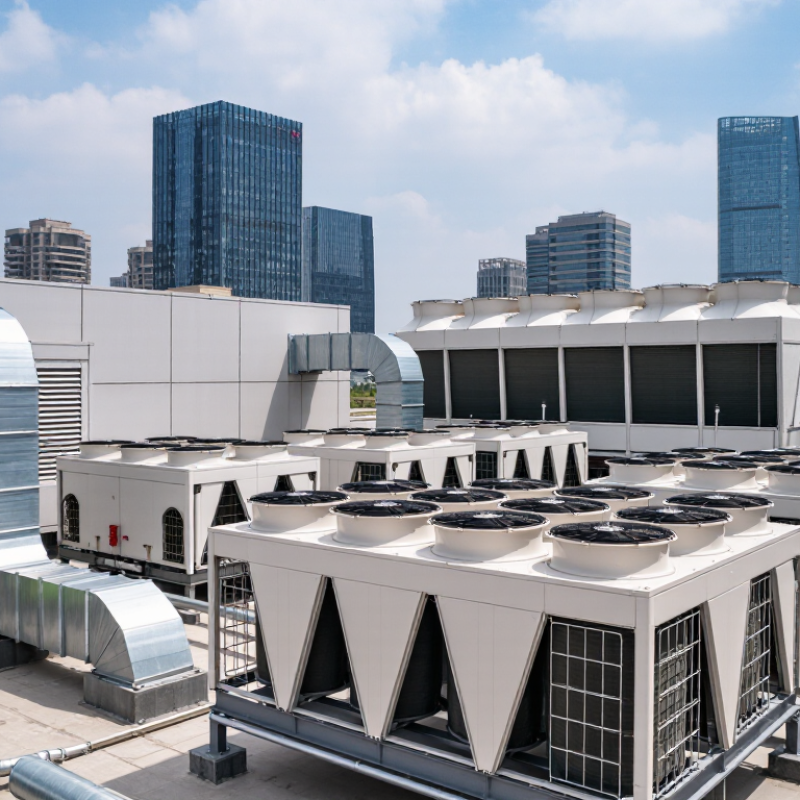
HVAC suppliers vary sharply by region because climate, building codes, and energy costs shape purchasing decisions. North American suppliers often serve large commercial buildings, warehouses, and residential replacement projects. European suppliers commonly emphasize heat pumps, low-carbon systems, and compact urban installations. In Asia and the Middle East, demand often centers on high-capacity cooling, humidity control, and equipment suited to dense construction.

Product category also reveals a supplier’s practical strengths.

Manufacturers may specialize in chillers, rooftop units, ductless systems, air handlers, compressors, or ventilation equipment. A reliable supplier should provide performance data, maintenance guidance, spare-part access, and clear warranty terms. Engineers should review seasonal efficiency, sound levels, refrigerant requirements, and operating temperatures.

A polished catalog is not enough.
Field records matter more.

Market position depends on more than shipment volume. Large suppliers may offer extensive technical support and stable production, while regional specialists can respond faster to unusual site conditions. Distributors add value through inventory, installation training, and local service teams. Buyers should compare delivery history, testing procedures, and after-sales response times.

Even experienced teams can misjudge replacement costs when labor and controls are excluded. That mistake deserves attention.

Supplier evaluations should remain practical, documented, and open to revision.

Energy Efficiency Benchmarks Under ASHRAE 90.1 and the EU Ecodesign Rules

Top HVAC and Air Conditioning Suppliers Worldwide

Energy efficiency claims should begin with measured performance, not catalogue optimism. ASHRAE 90.1 sets minimum requirements for equipment efficiency, controls, insulation, and system design in commercial buildings. Suppliers should provide verified SEER, EER, COP, and part-load data. These figures matter because HVAC systems rarely operate at full load.

The International Energy Agency’s The Future of Cooling report states that cooling uses about 10% of global electricity. It also warns that cooling demand could more than triple by 2050 without stronger efficiency measures. In Europe, Ecodesign rules establish minimum seasonal efficiency thresholds and product information duties. The European Commission’s 2019 Ecodesign Impact Accounting report projects about 167 TWh of annual savings by 2030 across covered products. A benchmark is not a promise. Real buildings remain messier.

Tips: Ask suppliers for independent test certificates, seasonal efficiency curves, standby consumption, and controls compatibility. Compare performance at 25%, 50%, and 100% load. Check refrigerant compliance under current EU requirements. Site conditions can change results sharply. Humidity, dirty filters, and poor commissioning often erase laboratory gains. I would also question unusually high efficiency claims without a clear test standard. Perfect data is rare. That deserves reflection.

Top HVAC and Air Conditioning Suppliers Worldwide - Energy Efficiency Benchmarks Under ASHRAE 90.1 and the EU Ecodesign Rules

Non-brand technical benchmark matrix for comparing HVAC and air-conditioning product specifications
ASHRAE 90.1 framework EU Ecodesign framework No company or brand data
Equipment category Typical capacity scope ASHRAE 90.1 benchmark basis EU Ecodesign benchmark basis Key efficiency metric Verified benchmark or regulatory anchor Supplier evaluation indicator
Small split air conditioners and heat pumps Up to 12 kW cooling capacity in the EU product-label scope Equipment efficiency tables and applicable test procedures; exact requirements depend on equipment type and capacity Regulation (EU) No. 206/2012, as amended, for air conditioners and comfort fans SEER for cooling; SCOP for heating EU minimum seasonal values include SEER 4.60 and SCOP 3.80 for the average climate classification Published seasonal test data, declared climate-zone performance, standby consumption and refrigerant compliance
Room air conditioners with energy labels Primarily residential and light-commercial units up to 12 kW Efficiency requirements are evaluated against the applicable 90.1 equipment provisions rather than EU label classes Regulation (EU) No. 626/2011 establishes the energy-label scale for air conditioners SEER and SCOP Cooling label classes range from A+++ to D; A+++ begins at SEER 8.50, while the minimum permitted class begins at SEER 4.60 Energy-label class, declared annual energy use, sound-power level and operating-temperature range
Packaged rooftop and unitary systems Commonly above 19 kW and extending into large commercial capacities Minimum efficiency is equipment- and size-specific under the mandatory tables in Section 6.8 Commercial air-heating and cooling products are covered by Regulation (EU) 2016/2281, where applicable IEER, EER, COP and seasonal space-cooling efficiency ASHRAE compliance cannot be represented by one universal number; capacity band, condenser type and heat-rejection method must be identified Part-load efficiency, economizer compatibility, fan power, controls and verified performance at design conditions
Air-cooled chillers Commercial and industrial chilled-water systems; capacity varies widely by application ASHRAE 90.1 uses capacity-specific minimum full-load and part-load efficiency tables Applicable large comfort-chiller requirements are addressed through Regulation (EU) 2016/2281 and related product rules kW/ton, COP, IPLV or NPLV, and seasonal space-cooling efficiency Lower kW/ton indicates better electrical efficiency; the required value must be matched to capacity, leaving-water temperature and rating conditions Part-load curve, condenser-fan control, low-ambient operation, refrigerant type and lifecycle serviceability
Water-cooled chillers Medium and large commercial or industrial chilled-water plants Equipment-specific minimum efficiency tables under Section 6.8, with separate full-load and part-load requirements Large comfort chillers and process-related products may fall under different EU Ecodesign product categories kW/ton, COP, IPLV or NPLV Plant-level efficiency should include chiller, condenser-water pumps and cooling-tower energy rather than chiller efficiency alone Integrated plant controls, variable-speed drives, approach temperatures, heat-recovery capability and water-treatment requirements
Variable refrigerant flow systems Multi-zone residential, commercial and light-industrial applications Applicable 90.1 provisions address minimum efficiency, controls, heat recovery and zoning according to system type Small systems may fall under Regulation (EU) No. 206/2012; larger commercial systems may be assessed under Regulation (EU) 2016/2281 SEER, SCOP, EER, COP and seasonal space-cooling efficiency Performance must be checked at representative part-load conditions and across the declared heating climate profile Simultaneous heating and cooling capability, heat-recovery efficiency, zoning controls and refrigerant charge management
Air-handling and ventilation equipment with cooling coils Commercial buildings, hospitals, offices and industrial facilities System-level requirements include fan power, outdoor-air controls, heat recovery and equipment efficiency where applicable Ventilation products are principally addressed by separate EU Ecodesign requirements; cooling-coil performance is often assessed as part of the system Specific fan power, heat-recovery efficiency, coil capacity and seasonal cooling efficiency The most meaningful comparison is total system energy, including fan power and pressure drop, not cooling capacity alone Heat-recovery effectiveness, filter pressure drop, fan efficiency, controls integration and commissioning support
Refrigerant and environmental compliance All equipment using fluorinated refrigerants ASHRAE 90.1 focuses primarily on building energy performance; refrigerant safety is addressed through separate safety and environmental standards Regulation (EU) No. 517/2014 and subsequent EU F-gas legislation restrict high-GWP refrigerant applications GWP, refrigerant charge, leakage rate and end-of-life recovery From 1 January 2025, single-split air-conditioning systems containing less than 3 kg of refrigerant with GWP of 750 or more are prohibited from being placed on the EU market Low-GWP refrigerant availability, technician requirements, leak detection, recovery procedures and future regulatory risk
Controls and operational efficiency All commercial HVAC categories ASHRAE 90.1 includes requirements for automatic controls, temperature control, demand limitation, economizers and scheduling, subject to system type and exceptions EU Ecodesign emphasizes declared seasonal performance, standby modes, product information and energy consumption over the product life cycle Part-load efficiency, standby power, control accuracy and annual energy use A high-efficiency product can underperform if controls, operating schedules, airflow, setpoints or maintenance are poorly configured Open-protocol integration, remote monitoring, fault detection, trend logging and documented commissioning procedures
Interpretation note: ASHRAE 90.1 requirements are normally capacity-, equipment-type- and rating-condition-specific, so a single universal efficiency value is not technically valid. EU Ecodesign thresholds also vary by product category, capacity and operating mode. Supplier comparisons should therefore use the same test standard, climate profile, capacity range, entering and leaving temperatures, and part-load assumptions.
Reference framework: ASHRAE Standard 90.1-2022; Commission Regulation (EU) No. 206/2012; Commission Delegated Regulation (EU) No. 626/2011; Commission Regulation (EU) 2016/2281; Regulation (EU) No. 517/2014 on fluorinated greenhouse gases.

Refrigerant Transition Guided by the Montreal Protocol and Kigali Amendment

Top HVAC and Air Conditioning Suppliers Worldwide

Refrigerant Transition Guided by the Montreal Protocol and Kigali Amendment

The global HVAC market is changing through controlled refrigerant transitions. The Montreal Protocol reduced ozone-depleting substances, while the Kigali Amendment targets high-global-warming-potential HFCs. These agreements influence equipment design, import rules, technician training, and refrigerant management across regions.

Reliable suppliers now offer systems designed for lower-emission refrigerants and improved energy performance. Buyers should examine technical data, safety classifications, service requirements, and local approval records. A responsible supplier can explain charging limits, recovery procedures, leak testing, and disposal practices in clear language. Vague climate claims deserve careful questioning.

Field experience also reveals practical difficulties. Existing equipment may operate for many years, yet replacement parts and refrigerant availability can change sooner. That gap matters. Contractors often need recovery cylinders, electronic leak detectors, ventilation controls, and updated training before installation. Small details affect safety.

National implementation schedules differ. A refrigerant accepted in one market may face restrictions elsewhere. Suppliers should provide current compliance documents and traceable refrigerant information. They should also support reclaimed refrigerant programs where suitable. However, lower global warming potential does not automatically mean lower risk. Some alternatives require different pressure controls, ignition precautions, or maintenance methods.

The transition is not perfectly smooth. Costs can rise, and older buildings may resist efficient upgrades. Still, careful supplier evaluation helps facility owners reduce leaks, prevent premature replacement, and align purchasing decisions with evolving environmental requirements.

Smart HVAC Growth Driven by Buildings’ 30% Share of Global Energy Use (IEA)

Top HVAC and Air Conditioning Suppliers Worldwide

Buildings consume roughly 30% of global energy, according to the International Energy Agency. The exact share changes with regional accounting methods. Still, the pressure is clear. Heating, ventilation, and air conditioning systems remain major energy users in offices, hospitals, factories, and homes. Smart HVAC suppliers now combine efficient equipment with sensors, automation, and continuous performance data.

A practical system can adjust airflow when a meeting room empties. Temperature sensors can identify uneven conditions near windows or exterior walls. Variable-speed drives reduce unnecessary motor operation. Connected controls also help technicians detect blocked filters, refrigerant issues, and failing fans earlier. These details matter. Small faults can quietly increase energy use for months.

Supplier quality requires more than attractive efficiency figures. Buyers should examine seasonal performance, control compatibility, installation training, spare-parts access, and independent testing. Commissioning is essential. Poor setup can undermine excellent equipment. Cybersecurity also deserves attention when HVAC controls connect to building networks. A dashboard may look impressive while the building wastes energy. That is an uncomfortable possibility. Operators should compare measured consumption before and after upgrades, not rely only on projected savings. Smart systems can reduce waste, but they are not automatically intelligent. Skilled maintenance, accurate sensors, and informed occupants still influence results. Performance may also decline when software updates, calibration, or local climate conditions receive little attention.

Smart HVAC Growth Opportunity: Buildings' Share of Global Final Energy Use

Global final energy consumption by sector, rounded estimate for 2022

Buildings account for approximately 30% of global final energy consumption, creating significant efficiency opportunities for heating, ventilation, air conditioning, and cooling systems. Improving HVAC performance can help reduce energy demand while supporting building decarbonization.

Source: International Energy Agency (IEA), global sectoral energy-use estimates. Values are rounded.