What Are the Best Home Air Conditioning Systems in 2026?
Choosing among home air conditioning systems in 2026 means looking beyond brand names and glossy efficiency labels. A quiet unit may still cool unevenly. An oversized system can switch on and off too often, leaving rooms clammy. The details matter: local summer humidity, insulation, window exposure, duct condition, and the number of people at home all affect comfort and running costs.
Building-science educator and HVAC professional Allison Bailes’s practical guidance can be paraphrased this way: choose equipment for the house, not the sales pitch. That is a useful starting point, not a substitute for a proper load calculation. A qualified contractor should assess the home, explain the sizing, and show how installation quality and maintenance affect performance. Ask about sound levels, filtration, warranties, and service access, too. Small omissions can become daily annoyances.
There is no universal winner. Really. A ducted heat pump may suit a well-insulated home, while a ductless mini-split can help cool a room without existing ducts. Some homes need a different approach. This guide compares common system types, efficiency, comfort features, and likely trade-offs to help homeowners ask sharper questions. One honest caveat: product ratings cannot predict every household’s experience, and installation can make or break even excellent equipment.
How Home Air Conditioning Systems Work
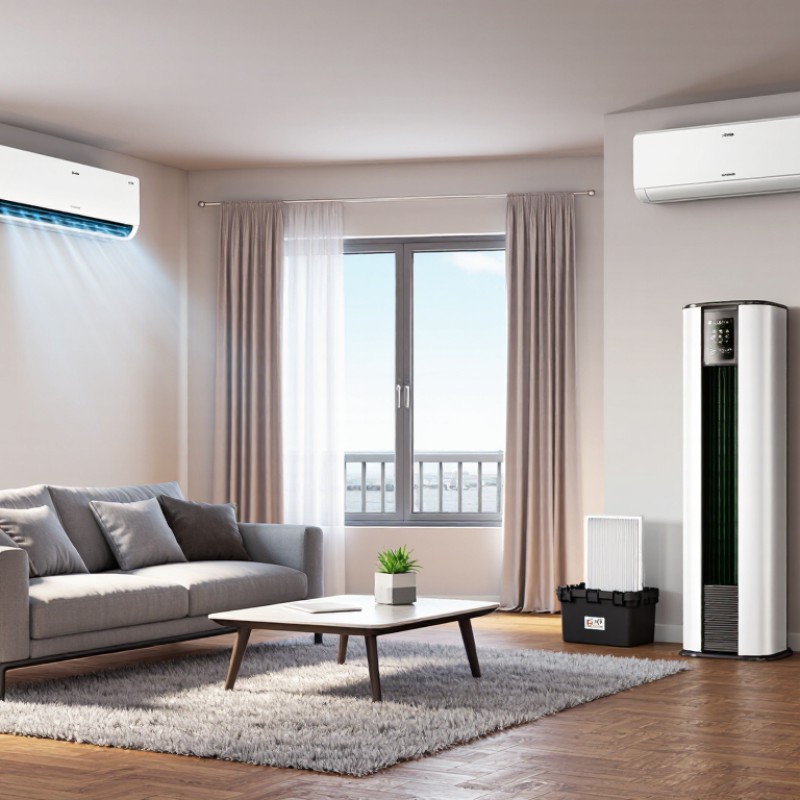
Home air conditioning does not create cold air; it moves heat from indoors to outdoors. Warm room air passes over a cold indoor coil, where refrigerant absorbs heat as it evaporates. A blower sends the cooled air back through ducts or directly into the room. That distinction matters.
A compressor raises the refrigerant’s pressure and temperature, sending it to the outdoor coil. There, a fan helps release indoor heat into the outside air, and the refrigerant condenses. An expansion device lowers its pressure before it returns indoors to absorb more heat. Repeated cycles. Many heat pumps reverse this process in cooler weather, moving heat indoors instead. Performance varies with outdoor temperature and equipment design. This is a simplified picture; controls and defrost cycles add exceptions.
For 2026, home options include ducted central systems, ductless mini-splits, and heat pumps. Each distributes conditioned air differently, and proper sizing can matter more than a headline efficiency figure. A qualified technician can assess room-by-room heating and cooling needs, duct leakage, and electrical capacity. At home, a clogged filter can restrict airflow, while closed vents may upset system balance. It is easy to blame the thermostat for discomfort, though the cause may be airflow or uneven temperatures between rooms.
What Are the Best Home Air Conditioning Systems in 2026? - How Home Air Conditioning Systems Work
| System type | How it works | Best suited to | Efficiency and controls | Main advantages | Considerations |
|---|---|---|---|---|---|
| Ducted central air conditioner | An outdoor unit releases heat from refrigerant, while an indoor coil absorbs heat from household air. A blower sends cooled air through ducts and returns warmer air to the system. | Homes with existing, well-sealed ductwork and a need to cool several rooms from one system. | Compare the matched system’s SEER2 rating. A single-stage unit generally runs at one output; two-stage and variable-capacity models can adjust output more closely to demand. | Can cool an entire home; uses existing ducts; many choices of capacity and control level. | Leaky or poorly insulated ducts can waste energy. Correct sizing, airflow setup, and regular filter and coil maintenance matter. |
| Air-source heat pump | In cooling mode, it works like a central air conditioner, moving indoor heat outdoors. A reversing valve changes refrigerant flow so the system can provide heat in cooler weather. | Homes seeking one ducted system for both cooling and heating, especially when replacing separate heating and cooling equipment. | Compare SEER2 for cooling and HSPF2 for heating. Performance in cold weather varies by model and outdoor temperature. | Provides heating and cooling in one system; can transfer heat rather than generate it directly during normal operation. | Installation cost, local climate, electricity rates, and any backup-heat needs should be considered together. |
| Ductless mini-split | An outdoor heat-pump unit connects by refrigerant lines to one or more indoor air handlers. Each indoor unit cools its zone directly, without central air ducts. | Homes without ducts, additions, converted garages, and households that want room-by-room temperature control. | Compare SEER2 and, for heating models, HSPF2. Multiple indoor units can provide separate zones, depending on system design. | Avoids duct losses; offers zoned control; can provide both cooling and heating when configured as a heat pump. | Indoor units are visible on walls or ceilings. Placement, condensate drainage, and professional installation affect comfort and appearance. |
| Packaged air-conditioning system | Cooling components are housed together in one outdoor cabinet. Ducts carry conditioned air to rooms and return air to the packaged unit. | Homes with limited indoor equipment space or existing duct connections designed for a packaged unit. | Compare the unit’s applicable SEER2 rating and confirm that the selected model and duct system are properly matched. | Keeps major components outside the living area and can connect to a home’s duct network. | Requires suitable outdoor space and ductwork. Equipment exposure to weather and service access should be considered. |
| Window air conditioner | A self-contained unit sits in a window or purpose-built opening. It draws room air across a cooling coil and exhausts heat outdoors. | Cooling one room, apartments where permanent system changes are impractical, or occasional supplemental cooling. | Energy labels and efficiency ratings differ by product category; compare the unit’s rated efficiency and capacity for the room. | Usually simpler to install than a whole-home system; provides direct cooling to one space. | Cools a limited area; window fit, security, noise, and blocked daylight can be concerns. |
| Portable air conditioner | A floor-standing unit cools room air and sends heat outdoors through an exhaust hose fitted to a window kit. Some models also collect or drain condensate. | Temporary or movable cooling where a window unit cannot be installed and ductless or central installation is not suitable. | Compare the applicable energy label, cooling capacity, and test method. Capacity figures may not be directly comparable across product types. | Does not require a permanent outdoor unit; can be moved between suitable rooms. | The exhaust hose must be sealed to the window. Units occupy floor space and may be noisier in the room than split systems. |
| Ground-source heat pump | A heat pump moves heat between the home and a buried ground loop. In cooling mode, it transfers indoor heat to the ground; the same system can provide heating. | Homes where site conditions, available land, and a long-term ownership plan can support ground-loop installation. | Compare certified cooling and heating performance ratings for the complete system; loop design and local ground conditions affect results. | Uses the relatively stable temperature underground as a heat source or sink; supplies both heating and cooling. | Ground-loop work can require substantial upfront investment, site access, and specialist design. |
Selection note: The best system depends on the home’s existing ducts, climate, room layout, electrical service, installation budget, and heating needs. Have a qualified professional calculate the cooling load and verify equipment sizing; efficiency ratings and minimum requirements vary by system type and location.
Related Posts
-

What Are the Top 10 Aircon Systems in China?
-
What is a Home Air Conditioning System and How Does It Work
-

How to Choose the Right Industrial Air Conditioning System for Your Business
-
China Top Air Conditioning Installation Companies?
-
10 Essential Tips for Choosing the Best Home Air Conditioning Systems in 2023
-

How to Choose the Right Air Conditioning Systems and Services for Your Home