What Are the Top Types of Industrial Air Conditioning in 2026?
Industrial air conditioning is not a one-size-fits-all purchase. A food-processing floor with warm, humid air has different needs from a warehouse filled with heat-sensitive goods. In 2026, the most relevant system types include chilled-water plants, packaged rooftop units, split and variable-refrigerant-flow systems, and evaporative cooling. Each handles space, heat, ventilation, and operating costs differently.
The right choice starts with the building’s actual cooling load, not a product label. Engineers typically assess equipment heat, occupancy, outdoor conditions, humidity, and required air changes. A chiller can serve large facilities through water pipes and air handlers, while rooftop units combine key components in compact packages. Split and VRF systems offer more independent zone control. Evaporative cooling can reduce energy use in suitable dry climates, but it adds moisture. That matters. A system that works well beside a loading dock may disappoint in a tightly controlled production room.
This guide compares these options by application, efficiency, installation demands, and maintenance needs. It also considers controls, filtration, and the availability of service support. Real-world performance depends on design and upkeep, so published efficiency figures are only part of the decision. The comparison is not a substitute for a site assessment. Still, it can help facility managers ask sharper questions before requesting proposals.
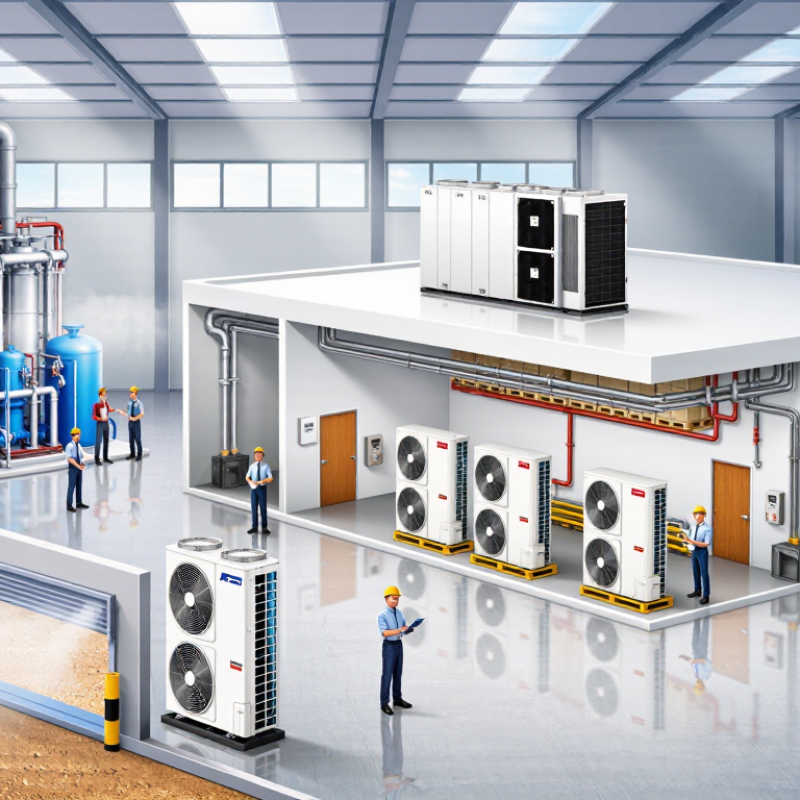
How Industrial Air Conditioning Systems Are Classified in 2026
Industrial air conditioning is best classified by what it cools, how heat moves, and where equipment sits. For occupied factory spaces, systems may use direct expansion, where refrigerant cools air locally, or chilled water, where a central plant sends cooled water to air-handling units. Process cooling is different: it controls equipment, products, or production rooms, often within tighter temperature limits. That distinction matters.
The International Energy Agency’s 2018 report, The Future of Cooling, estimated that space cooling used about 10% of global electricity. UNEP’s 2023 Global Cooling Watch projected cooling demand could more than triple by 2050 without stronger efficiency measures. These figures cover cooling broadly, not industrial systems alone. Still, they show why classification should include energy source and operating conditions, not just equipment names.
A useful second lens is heat-rejection method. Air-cooled chillers release heat outdoors through fans; water-cooled systems use cooling towers and need water treatment. Evaporative cooling can work well in dry climates, but humidity and water availability limit it. Small control rooms may need dedicated precision cooling, while a large production hall may suit central air handling. Real sites often combine types. That can complicate maintenance—and deserves a careful site assessment.
| System Type | How It Works | Typical Applications | Key Advantages | Important Considerations |
|---|---|---|---|---|
| Central Chilled-Water System | A chiller cools water, which is circulated to air-handling units or fan-coil units that cool and distribute air. | Large factories, warehouses with conditioned work areas, hospitals, laboratories, and multi-zone facilities. | Handles large, distributed cooling loads; supports zoning; can serve multiple air handlers from a central plant. | Requires space for plant equipment, water piping, controls, and ongoing maintenance. Efficiency depends on system design, operating conditions, and load management. |
| Direct-Expansion (DX) Packaged System | Refrigerant removes heat directly at the indoor coil. Packaged units typically combine major refrigeration components in one cabinet and deliver conditioned air through ducts. | Workshops, production areas, small industrial buildings, and facilities needing a relatively self-contained system. | Can be simpler to install than a central chilled-water plant and is available in a range of configurations. | Unit placement, duct design, outdoor conditions, and access for servicing affect performance. Large or highly zoned facilities may need multiple units or another system type. |
| Split and Multi-Split DX Systems | Separate indoor and outdoor components exchange heat through refrigerant lines. Multi-split arrangements connect multiple indoor units to outdoor equipment. | Small production rooms, offices within industrial sites, control rooms, and localized cooling zones. | Provides independent zone control and can be installed without extensive central ductwork. | Suitability depends on the required capacity, refrigerant-piping limits, ventilation needs, and operating conditions. It may not be appropriate as the sole solution for a large plant. |
| Variable Refrigerant Flow (VRF) System | A heat-pump or heat-recovery arrangement varies refrigerant flow to multiple indoor units, allowing different zones to be controlled independently. | Industrial offices, laboratories, and mixed-use facilities with many separately controlled spaces. | Flexible zoning and, in heat-recovery configurations, simultaneous heating and cooling in different zones. | Requires careful system design, controls integration, and qualified installation. It is generally used for building comfort conditioning rather than as a replacement for dedicated process cooling. |
| Evaporative Cooling | Water evaporation cools incoming air. Direct systems add moisture to the air; indirect systems transfer cooling through a heat exchanger with less added moisture to the supply air. | Ventilated workshops, agricultural buildings, and other spaces where outdoor-air cooling is suitable. | Can reduce reliance on compressor-based cooling under favorable climate and ventilation conditions. | Cooling effectiveness depends strongly on outdoor humidity and design. Water quality, hygiene, ventilation, and humidity requirements must be considered. |
| Dedicated Process Chiller | A refrigeration circuit cools a fluid, commonly water or a water-based solution, which carries heat away from production equipment or a process. | Manufacturing machinery, process lines, material cooling, and other applications requiring controlled process-fluid temperatures. | Can provide stable, application-specific fluid cooling and can be designed around process loads. | Capacity, temperature range, fluid compatibility, redundancy, and heat rejection must be matched to the process. It does not necessarily provide building ventilation or comfort cooling. |
| Hybrid or Integrated Cooling System | Combines two or more approaches—for example, mechanical cooling with evaporative assistance, or separate systems for process loads and occupied spaces. | Facilities with variable loads, different temperature requirements, or a mix of production and occupied areas. | Allows system components to be selected for distinct operating conditions and zones. | Controls, maintenance, and system interactions require coordinated design. Benefits depend on the site’s climate, operating schedule, and load profile. |
Classification note: Industrial air-conditioning systems are commonly compared by cooling method, distribution arrangement, control strategy, and whether they serve building comfort or a specific process. Actual suitability and performance depend on the facility’s heat load, ventilation requirements, climate, operating schedule, and design.
Related Posts
-
China Top Air Conditioning Installation Companies?
-
Top Industrial Air Conditioning Manufacturers Worldwide?
-

What Are the Best Home Air Conditioning Systems in 2026?
-
Top 10 Air Conditioning Systems to Beat the Heat in 2023
-
What is a Home Air Conditioning System and How Does It Work
-
Top 10 Air Conditioning Tips to Save Energy and Beat the Heat