Top Air Conditioning Manufacturers Worldwide
Choosing a top air conditioning manufacturer requires more than comparing logos or annual sales. This guide examines global companies through engineering performance, product reliability, energy efficiency, and after-sales support. It considers brands serving homes, offices, factories, hospitals, and data centers. Each market demands a different answer. A quiet wall-mounted unit may suit a bedroom, while a modular chiller must manage thousands of square meters. We will review published specifications, certification practices, warranty terms, and independent market evidence where available. The discussion also recognizes regional conditions, including humid coastlines, dusty cities, freezing winters, and unstable power supplies. These details often determine whether a system performs well beyond its showroom demonstration.
Readers will find practical context about compressors, inverter control, heat pumps, refrigerant choices, filtration, controls, and maintenance networks. Energy labels matter, but real performance depends on installation quality, airflow design, cleaning schedules, and local technicians. A premium unit can disappoint when its drain line is poorly fitted. Small details matter. The manufacturers discussed here have broad influence, yet no company leads every category or climate. Rankings can also shift as regulations, technology, and supply chains change. That is an important limitation. This introduction avoids treating advertising claims as final proof. It encourages comparison using transparent data, lifecycle costs, noise levels, spare-parts access, and verified user experience. Whether planning a single-room upgrade or commercial project, seek dependable guidance. Choose heating and air conditioning equipment suited to its actual environment.
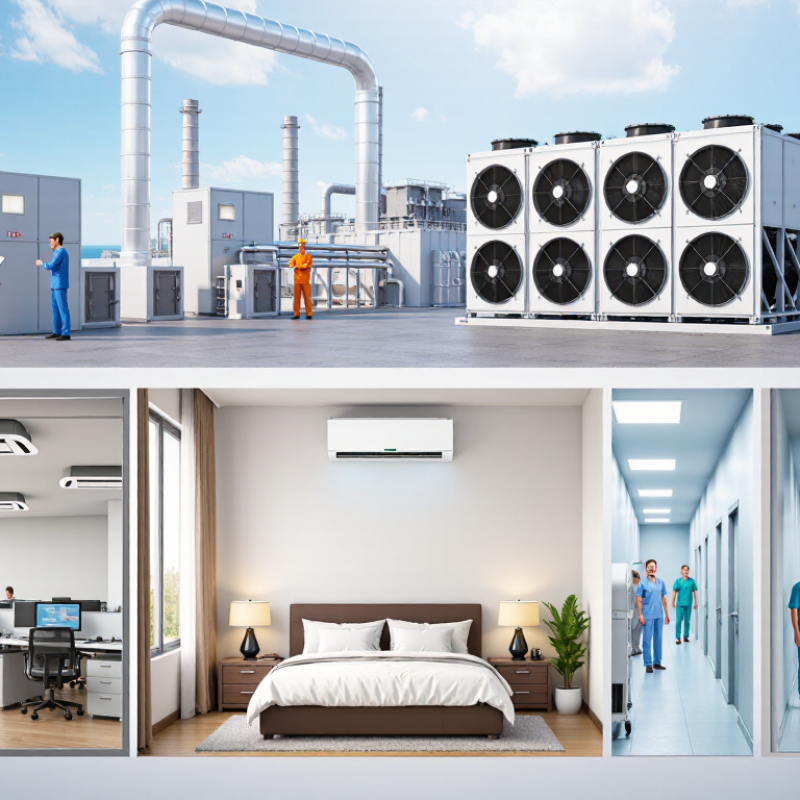
Global Air Conditioning Industry Overview
Top Air Conditioning Manufacturers Worldwide
Global Air Conditioning Industry Overview
The global air conditioning industry is shifting from simple cooling toward measured indoor comfort. Manufacturers now develop split systems, variable refrigerant equipment, rooftop units, and large chilled-water plants. Demand grows in dense cities, hospitals, data centers, and warmer residential markets. Yet sales figures alone can mislead. They may hide installation quality, service coverage, and electricity use.
Field assessments often show that efficiency depends on the whole system. A high-rated unit can perform poorly with undersized ducts, blocked filters, or weak commissioning. Refrigerants, compressors, controls, and heat exchangers influence seasonal performance. Regional climate matters too. A humid coastal home needs different control logic than a dry inland warehouse. Noise matters. Parts access matters.
Manufacturers compete through lower energy consumption, connected monitoring, heat-pump capability, and dependable after-sales support. Production is spread across major industrial regions, while components often cross several borders before final assembly. This creates scale, but it also exposes the industry to shipping delays and material shortages. Certification requirements differ between markets, complicating product design. The analysis remains imperfect because laboratory ratings rarely reflect every occupied building. A technically advanced model may fail commercially if technicians cannot service it. The industry still needs better lifecycle data, clearer repair guidance, and more honest comparisons between testing and daily use.
Top Air Conditioning Manufacturers Worldwide - Global Air Conditioning Industry Overview
| Category | Data Dimension | Global Indicator | Industry Relevance | Reference / Period |
|---|---|---|---|---|
| Market Scale | Installed room air-conditioning stock | More than 2 billion units worldwide | Reflects the large installed base requiring replacement, servicing, and efficiency upgrades. | International Energy Agency, 2018–2021 estimates |
| Electricity Demand | Electricity used for space cooling | Approximately 10% of global electricity consumption | Cooling efficiency is a major factor in electricity-system planning and peak-load management. | International Energy Agency, 2018 assessment |
| Geographic Demand | Primary growth markets | Asia-Pacific, Middle East, Africa, and Latin America | Population growth, urbanization, rising incomes, and hotter summers are expanding cooling demand. | IEA and UNEP regional outlooks |
| Product Mix | Residential air-conditioning formats | Room air conditioners, split systems, multi-split systems, and portable units | Split systems remain widely used because of installation flexibility and high seasonal efficiency. | Global product and regulatory classifications |
| Commercial Systems | Common commercial technologies | Variable-refrigerant-flow systems, rooftop units, chillers, and air-handling systems | Selection depends on building size, climate, zoning, ventilation, and operating schedule. | ASHRAE and international HVAC classifications |
| Efficiency Technology | Variable-speed compressor adoption | Increasingly common in new residential and commercial equipment | Inverter control can improve part-load efficiency, comfort, and seasonal energy performance. | Energy-efficiency programs and product standards |
| Refrigerants | Lower-global-warming-potential refrigerants | R-32, R-290, R-454B, and other alternatives are used or being introduced depending on market rules | Refrigerant choice is shaped by safety classification, climate impact, equipment design, and local regulation. | Montreal Protocol and national regulations, 2024 |
| Regulation | Hydrofluorocarbon phase-down | The Kigali Amendment targets a global reduction in high-GWP HFC consumption | Manufacturers are redesigning products, refrigerant circuits, and service practices. | Kigali Amendment to the Montreal Protocol |
| Climate Impact | Direct and indirect emissions | Energy consumption generally represents the larger lifetime climate impact | Efficient equipment, low-carbon electricity, leak prevention, and proper end-of-life recovery are essential. | UNEP cooling-emissions assessments |
| Standards | Energy-performance metrics | SEER, EER, CSPF, COP, and seasonal efficiency ratings are used across different jurisdictions | Direct comparisons require checking the test method, climate zone, and rating period. | ISO, IEC, regional, and national standards |
| Manufacturing Footprint | Global production concentration | East Asia is a major global production and component-manufacturing base | Supply chains commonly include compressors, heat exchangers, motors, controls, and refrigerant components. | International trade and manufacturing statistics |
| Industry Structure | Competitive factors | Energy efficiency, reliability, service coverage, installation quality, and total cost of ownership | Product performance alone does not determine lifecycle value; maintenance and commissioning are also critical. | HVAC industry practice and procurement criteria |
| Future Outlook | Key growth and innovation themes | Electrification, heat pumps, smart controls, demand response, and thermal-energy optimization | The market is shifting toward efficient, connected, low-emission systems that support grid flexibility and indoor comfort. | IEA, UNEP, and international energy-efficiency outlooks |
Note: Figures and statements are global industry indicators compiled from publicly available international energy, environmental, standards, and HVAC-sector assessments. Market definitions, test methods, and reporting periods may vary by country.
Related Posts
-

What Are the Top Air Conditioning Types in China?
-

2026 Top Types of Heating and Air Conditioning Systems?
-

Understanding the Benefits of an Air Conditioning Box for Energy Efficiency
-
2026 Best Residential Air Conditioning Systems for Homeowners?
-
Top HVAC and Air Conditioning Suppliers Worldwide
-
What is Domestic Air Conditioning and How Does It Work?